How to Learn and Remember Ballet Choreography
To master ballet choreography, break sequences into small 'chunks' or 'anchor points,' associate movements with specific musical cues, and use verbal shorthand to name each step. Consistent repetition builds muscle memory, while mental visualization and transcribing the steps onto paper help bridge the gap between learning a combination and performing it fluidly.
Learning and remembering choreography is not an innate talent; it is a cognitive and physical skill that you can develop with practice. For adult dancers, the challenge often lies in the transition from technical execution to artistic flow. At Broche Ballet, where our library includes over 7,200 on-demand videos, we emphasize that 'brain work' is just as important as 'leg work.' Here is how to master the art of memorization.
Use 'Chunking' and Patterns
The human brain is better at remembering groups of information than isolated facts. Instead of trying to remember sixteen individual steps, look for patterns. Most ballet combinations are built on phrases of four or eight counts. Identify the 'theme' of a sequence—such as a series of balancés or a repetitive port de bras—and group them together. Our program Confused by Choreography? Start here! specifically teaches you how to recognize these movement structures so you aren't overwhelmed by the sheer volume of steps.
Identify Musical and Emotional Anchor Points
Music is your strongest ally in memorization. Rather than counting strictly (1, 2, 3, 4), listen for melodic shifts, crescendos, or specific instruments. In our Choreography Class #5, we explore the concept of 'anchor points'—specific moments in the music that align with a key step or emotion. If you know that a piqué arabesque happens exactly when the melody reaches its peak, your body will begin to react to the music automatically, reducing the cognitive load on your brain.
Verbalize and Transcribe
Adult learners often benefit from multiple modes of sensory input. As you learn a combination, whisper the names of the steps (e.g., 'tendu, jeté, piqué, close'). This converts physical movement into language, which the brain processes differently. For more complex variations, try writing the steps down. The Confused by Choreography? Start here! program introduces choreographic transcription, a powerful tool for visual and tactile learners to map out a dance on paper before attempting it on the floor or after class to solidify memory.
Master the Art of Reversing
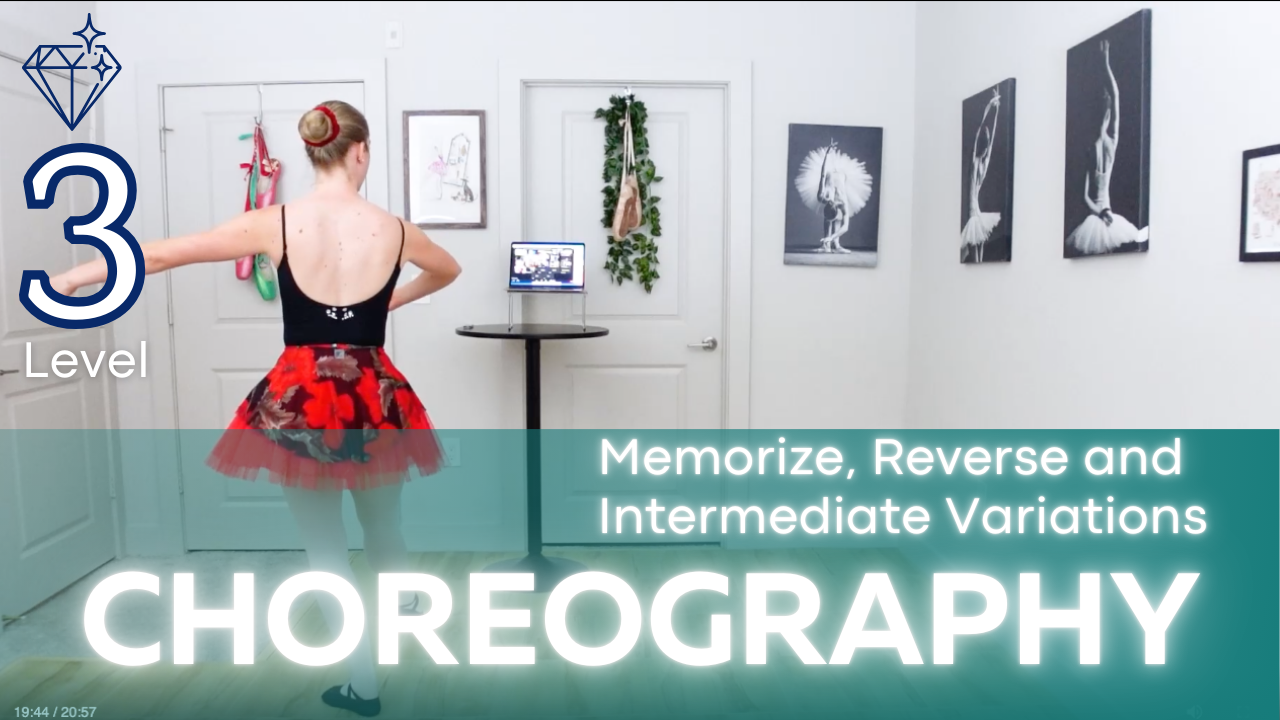
In a typical ballet class, you perform a combination on the right and then immediately on the left (en dedans or simply the other side). This is often where adult dancers feel the most 'scrambled.' The secret is to understand the logic of the movement rather than just the direction. Our program Reverse and Memorize with Ease focuses specifically on this skill, helping you translate sequences across the sagittal plane of the body. Once you understand the geometric relationship of the steps, reversing becomes a mathematical exercise rather than a memory struggle.
Build Muscle Memory through Smart Repetition
Muscle memory is the point where your nervous system takes over, allowing your conscious mind to focus on artistry rather than 'what comes next.' Once you have seen the common patterns many times, they will begin to become second nature and will help your memorization improve.
Address the 'Adult' Factor
Adults often experience higher levels of performance anxiety or frustration when they 'blank' on a step. Remember that your brain is juggling a lot—career, family, and the technical demands of turnout and posture. If you lose your place, look for your next 'anchor point' and rejoin the sequence there. Our Advancing Technique with Posture, Turnout and Ballet Lines program helps you build the physical stability needed so that your body feels safe enough to let your mind focus on the choreography.
Learning choreography is a journey of connecting the mind to the muscles. By using structured programs like The Facets of Ballet, you can build a roadmap that turns the 'confusion' of a new combination into the joy of effortless movement. Keep practicing, be patient with your progress, and remember that every professional dancer started exactly where you are today.
Next step
Related Videos
Watch classes and tutorials related to this topic
 9:13
9:13 Practice Reversing: Train your Memory with this Intermediate Tendu Combination
 6:04
6:04 Journal right after class to Improve your Memory | Journal with Julie
 52:56
52:56 Intermediate Ballet Barre: Strength and Practice Memorizing Port de Bras
 15:09
15:09 Memorizing & Reversing a Challenging Tendu Combination -- Come if you struggle to memorize!
 25:09
25:09 Boost your Ballet Brain: How to Memorize Combinations | Broche Banter Season 3 Episode 48
 20:12
20:12 A Study of Poses and Positions: Croisé, Éffacé, Écarte and all 6 Arabesques
 27:37
27:37 Types of Turns | Class #2 | Bridging the Gap Between Beginner & Intermediate Center
 39:38
39:38 Double Barre - Simple high-repetition combinations repeated twice ("double") for stamina
More Programs
Confused by Choreography? Start here!
Learn the basics of choreographic transcription and writing. Master a variation that challenges your skill set while expanding your understanding of how movement is structured and communicated.
33 classes
From Fear to Fun - Enter the Center with Confidence
Do you experience "center panic"? If stepping away from the barre feels daunting, this program is your solution. Build balance, stability, and trust in your body as you develop the skills to approach center work with poise and confidence.
105 classes
Waltz, Dance, and Level up your Center
SKILLS: Learning longer combinations and linking steps together. VOCABULARY: Pas de Bourrée with Pickups, Leveling Up Your Waltz Vocabulary (8-Week Series), Piqué Ballonné (on flat), Promenade, Piqué Fouetté, Fouetté Sauté, Promenade Fouetté, 8th Port de Bras.
89 classes