How Do I Do a Pirouette?
A successful pirouette requires a deep, stable plié, a powerful push to a high relevé, and a sharp head 'spot' to maintain orientation. Instead of focusing on spinning, think about lifting vertically while holding a clean passé position. Success comes from mastering the balance first, then adding the momentum of the turn.
A pirouette is one of the most iconic movements in ballet, yet it often feels like a daunting feat of physics for adult dancers. Whether you are returning to the studio after a hiatus or starting your journey today, the secret to a great turn isn't in the 'spin'—it is in the 'lift.'
At Broche Ballet, we approach turning as a skill built through layers of stability and coordination. Our library includes over 8,000 videos, with nearly 200 specifically dedicated to the mechanics of turning, ensuring you have the tools to progress safely at any age.
The Foundation: A Controlled Preparation
Every pirouette begins with the preparation. Most adult dancers struggle with turns because their setup is unstable. Usually performed from fourth or fifth position, as you plié, your heels must stay grounded to provide the leverage needed for the 'push.' Maintain the turnout from your hips to build energy and momentum during the preparation, and brace your core for the turn.
In our Your first Pirouettes program, we emphasize that a shallow plié leads to a weak turn. Think of your legs like a spring: the deeper and more controlled the coil, the more power you have to rise.
The Ascent: Finding Your Axis
The moment you leave the floor, you are moving from two feet to a narrow demi-pointe on one leg. This transition is where most balance is lost. Instead of thinking about going 'around,' focus on going 'up.' Your standing leg must be completely straight, and your core must be engaged to keep your ribs over your hips.
To build the necessary ankle stability for this moment, we recommend the Power Barre for Strong Legs and Demi-Pointe video. It focuses on the specific calf and foot strength required to hold your axis during a rotation. If your ankle wobbles, the turn will collapse; if your axis is vertical and strong, the rotation happens naturally.
The Shape: The Passé or Retiré Position
While turning, your working leg is held in a 'passé' or 'retiré' position. For adults, hip flexibility can sometimes make a high passé difficult. It is more important to have a stable, turned-out shape than a high knee that causes your pelvis to tilt.
Our Advancing Technique with Posture, Turnout and Ballet Lines program helps you find the 'harmony' between your standing hip and your working leg. By keeping your hips level, you ensure that your center of gravity remains over your supporting foot, which is the only way to stay balanced while spinning.
The Secret Sauce: Spotting
Spotting is the rhythmic movement of the head that helps you complete the rotation. You choose a fixed point at eye level, keep your eyes on it as your body begins to turn, and then whip your head around to find that point again before your body finishes the circle.
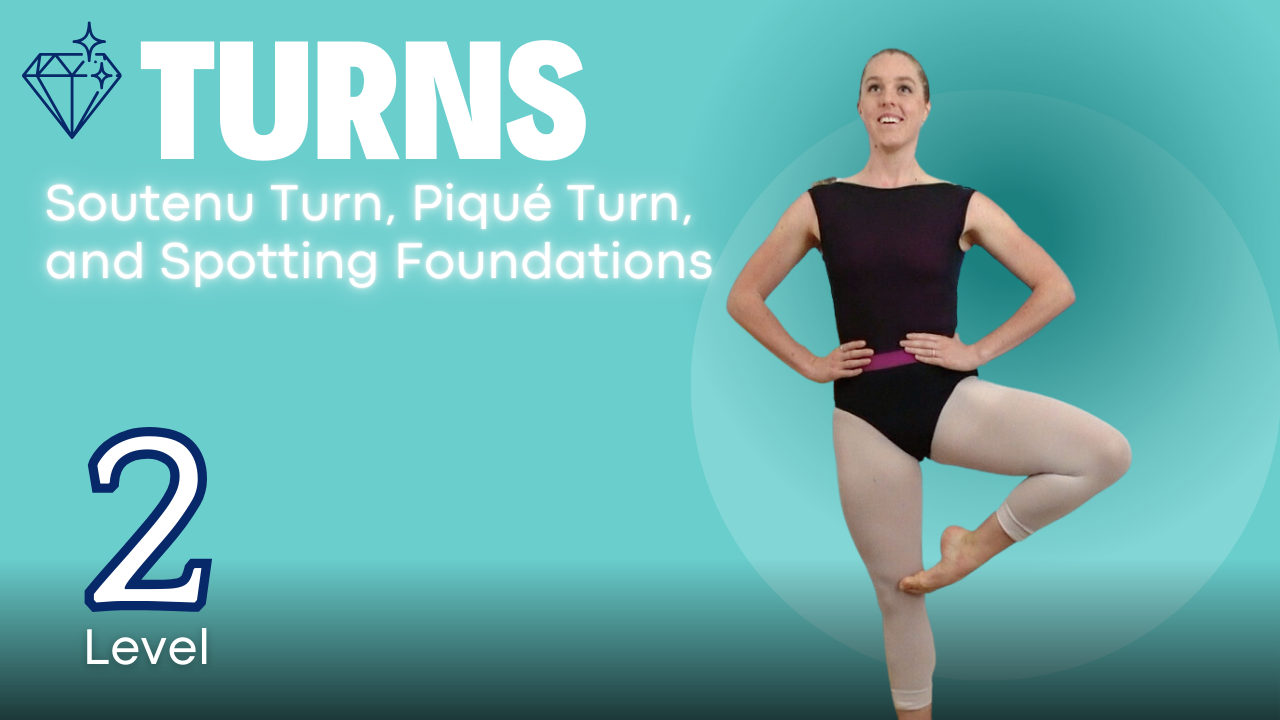
If you find yourself feeling nauseous or losing your direction, the Turns Foundations Program offers 25 videos specifically on spotting. For adults, spotting isn't just about technique; it's about retraining the vestibular system to handle rotation, which can take a bit more time than it does for younger students.
Adult-Specific Considerations
It is common for adult dancers to feel a 'fear of falling' or to worry about their knees. This is why we recommend starting with 'quarter' and 'half' turns at the barre before moving to the center. Programs like Your first Pirouettes break down the mechanics into 93 manageable videos, starting with 'Soutenu' turns that keep both feet on the floor, gradually building the confidence to lift into a full pirouette.
Consistency is your best friend. Even five minutes of balancing in a retiré position daily will do more for your pirouettes than an hour of erratic practice once a week.
Mastering the pirouette is a journey of refinement. By focusing on your vertical alignment and a clean preparation, you take the 'luck' out of turning and replace it with reliable, repeatable technique. Keep your eyes on your spot and your energy lifting toward the ceiling!
Next step
Related Videos
Watch classes and tutorials related to this topic
 51:58
51:58 Power Barre - Extra Spicy Exercises for better turns & jumps
 17:22
17:22 Turning Drills for Mastering Pirouettes: A Step-by-Step Guide
 12:46
12:46 Learning how to Spot your En Dehors Pirouette
 26:53
26:53 All-level Ballet Center With Lots of Pirouette Practice
 13:26
13:26 Pirouettes at the Barre - Class #1 -- the 3 Principles of Turns at Barre
 16:17
16:17 Mastering Pirouettes - Class #5 - Stop Falling out of your Turns
 14:44
14:44 Advanced Turning Drills - Short, Sweet and Effective Drills for Double Pirouettes
 11:33
11:33